Get a detailed ethnicity percentage breakdown, country-by-country origins, and feature-level analysis in under a minute.
Most people use race and ethnicity as if they mean the same thing. They don’t — and understanding the difference matters if you want a real answer to the question of what is my race and ethnicity.
All three of these dimensions layer together to form something larger: your ethnic background. And while no app can fully capture the complexity of that story, an AI ethnicity identifier can give you a genuinely compelling starting point.
The search query “what is my race” generates hundreds of thousands of searches every month. That number reflects something real: identity is a universal preoccupation, and for a growing number of people, the answer isn’t obvious. The common thread across all of these is that people are looking for a story — not just a label. They want to understand where they come from, and why they look the way they do.
A face scan for ethnicity might sound like science fiction, but the underlying logic is grounded in well-established research into human facial morphology — the way physical features vary systematically across populations with different geographic origins.
The basic principle: over thousands of years, populations that lived in geographic isolation developed measurable patterns in their facial structure. The shape of the orbital socket. The height and width of the nasal bridge. The prominence of cheekbones. The distribution of soft tissue across the face. These characteristics are heritable, and they cluster in ways that correspond with ancestry.
An AI face ethnicity analyzer is trained on a large, diverse dataset of faces with known ancestry information. The model learns to recognize these patterns. When you upload a new photo, it runs a facial ethnicity test by measuring dozens of features and comparing them against those learned population clusters. The output is a probabilistic estimate: this face shares characteristics most commonly associated with these ethnic groups, in roughly these proportions.
It’s not a genetic test — it can’t be, because genes aren’t visible. What it is is a sophisticated, well-trained read of the physical signals that ancestry tends to leave on a face. And for most people, the results are recognizable and often genuinely surprising in their specificity.
Shape, depth, and spacing of the eye sockets — variable across East Asian, European, African, and Middle Eastern populations.
Bridge height and width, tip projection, nostril width — among the most ethnically variable features on the human face.
Cheekbone prominence and forward projection, markedly different between East Asian and European ancestry patterns.
Jawline angle and chin projection — useful in distinguishing Southeast Asian, African, and European patterns.
The forward or backward projection of the lower face, highly variable across populations worldwide.
Supporting evidence when visible in the image to complement the structural analysis.
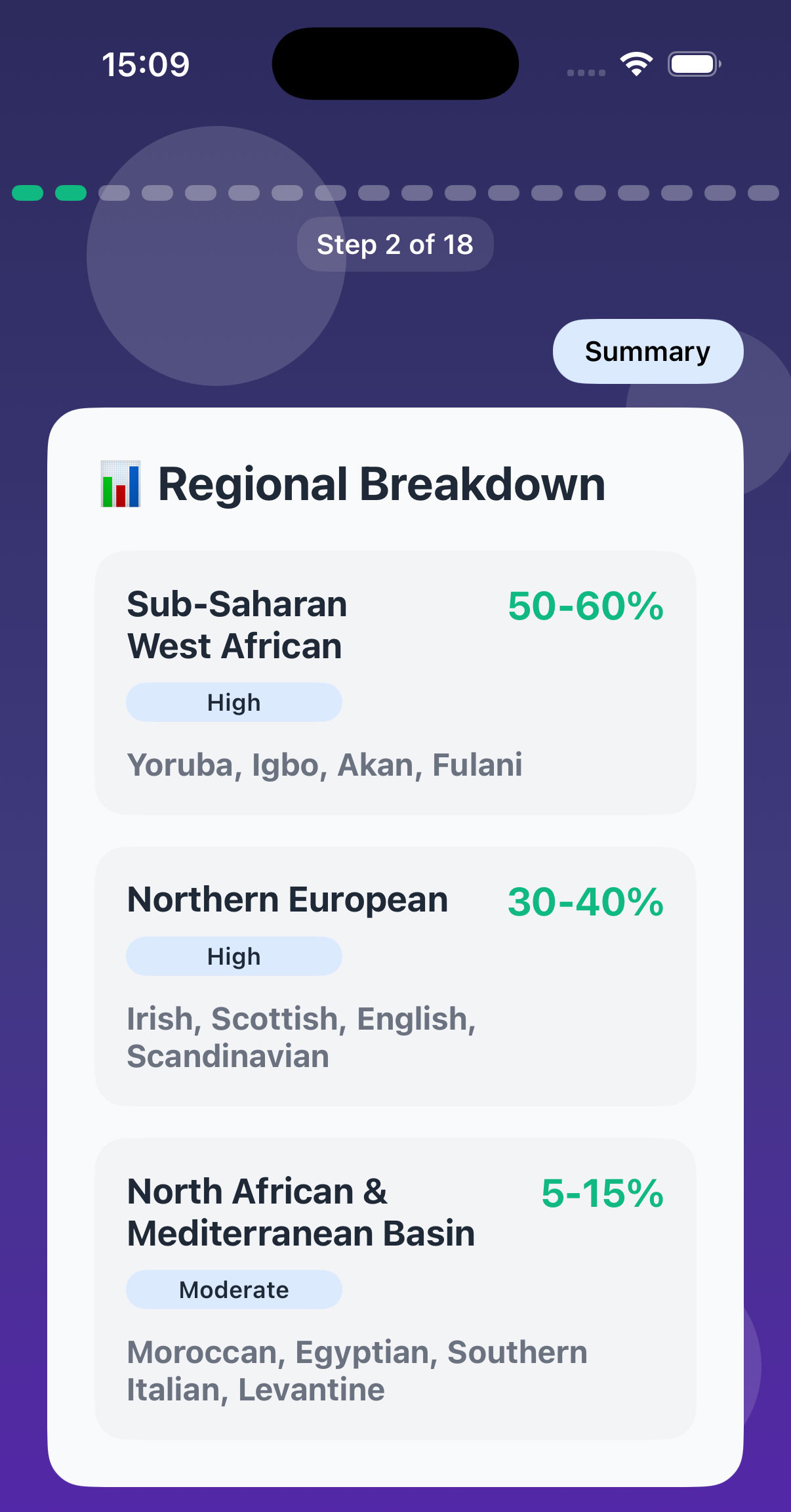
Most ethnicity tools online give you a broad category and call it a day. Ethnicity AI was built to do something more genuinely useful: break down your ethnic background with enough granularity that the result actually tells you something. Here’s what you get when you run a photo through the app:
“The same face can carry echoes of a Silk Road merchant, a West African farmer, an Iberian sailor, a Central Asian nomad.”
If you’ve been asking yourself how do I find out my ethnicity, you have three main options. Each has a different profile of speed, cost, depth, and precision. Here’s an honest look at all three. The most rewarding approach is usually to combine all three — start with a face ethnicity analyzer for instant exploration, follow up with a DNA test for genetic confirmation, then use both sets of results to guide genealogical research, filling in the human story behind the numbers.
It would be easy to reduce all of this to data: percentages, population clusters, feature measurements. But ethnicity, at its core, is a human story.
The same face can carry echoes of a Silk Road merchant, a West African farmer, an Iberian sailor, a Central Asian nomad. The boundaries between ethnic groups have never been clean — they’ve always shifted with trade, migration, conquest, and love. When you ask what is my ethnic background, you’re really asking about all the journeys that had to happen for you to exist.
A facial ethnicity test gives you a window into that story. Not the whole picture — no tool could be. But a beginning. And sometimes a beginning is exactly what you need to start asking the right questions.
Understanding the difference between ethnicity, race, and nationality is the foundation of this whole conversation. Race groups people by visible physical traits and is largely a social construct. Nationality is simply the country you hold citizenship in. Ethnicity goes deeper — it’s the full picture of your ethnic background: shared ancestry, language, culture, and history. When people talk about wanting to know their ethnic background, they’re usually asking about all three at once.
On the technology side, a face scan ethnicity tool — also called a facial ethnicity test, an ethnicity identifier, or a photo ethnicity analyzer — works by reading the physical signals ancestry leaves on a face. A face ethnicity analyzer measures dozens of facial features and matches them against known population patterns. Some tools go further, functioning as a nationality face scanner that maps those features to specific countries and regions. The result is a probabilistic estimate of your origins, delivered in seconds from a single photo.